Wednesday, February 24, 2016

Is financial collaboration possible?

By Ryan

I find myself often stressing about being a good steward of the support entrusted to us. Money issues here in Congo are so very different than what I know. I recently wrote this response to a friend who wanted to donate to us.

Thanks so much for your willingness to partner with us. The needs are great here and financial support is greatly appreciated. Right now the main source of expense we have is on patient care. Shannon is able to pay for patients' medical bills and generally spends about $1000-1500 per month. Our current support level is able to cover this and our other living expenses, especially since Samaritan's Purse covers much of these.

The really challenging thing here is that money does not solve heart issues and can provoke them. We are seeking wisdom on how to partner with the hospital, but corruption, mismanagement of resources, lack of communication, and little to no maintenance make both big and little support a huge challenge. For example, I have wanted to update the laboratory here for about $15,000, but there is no financial system in place to ensure that consumable test supplies are replenished. Practically everything here is hand to mouth. There are no budget or savings accounts. They make decisions based on how much money is in the cash box at that moment. It is horribly short-sighted and makes planning for any projects practically impossible. I am also interested in investing in a solar energy system for around $250,000, but right now there is no one here who is capable of maintaining this system and there is not a clear system of reserving money to ensure that the batteries are replaced every 5 years.

All this to say we would love your financial support, but we also really need your prayers for wisdom in how to use the support we have been entrusted with.

Much like a parent teaching personal finance to teenager, it is a hard place to be when you want to help and have the financial resources to help, but you also understand that helping by just giving will do more harm than good. The difficulty, just like parenting, is that it is a lot of work to take the time to teach financial responsibility. It is even more difficult when you take culture into consideration. In this culture, financial resources are meant to be consumed as soon as they are available, and if you do not consume them your community will come asking for them and if you do not give to those who ask you are often ostracized.

Often I feel like missionaries are primarily viewed by the Congolese as fundraisers, and if we are not bringing in money, we are chided.

The systems of Africa, as described in the book “African Friends and Money Matters,” is microeconomics-focused, whereas Americans see things in terms of macroeconomics. A prime example of this is that, here, broken-down cars are often repaired in the middle of the road and not moved to allow traffic to flow normally. This short-sighted advantage helps the owner of the car but hurts the entire system of traffic movement. It is this micro vs macro view that can, in part, describe why traffic rules are not followed in much of Africa. Everyone seeks to get a small advantage for themselves at the cost of the entire system breaking down. Completely blocked roads from traffic jams in Kinshasa are often the result of multiple cars passing other cars in oncoming traffic lanes, resulting in 5 cars face-to-face with 5 other cars on a 2 lane road. That leads to a 3 hour delay as cars disentangle.

Another challenge described by a fellow missionary here in Vanga is learning to be patient. One of the tactics of the hospital is that when a critical need is brought up and identified, they will wait until the missionaries lose patience and pay for it. This tactic, mixed with a lack of will to get certain issues addressed, leads to lots of delays and a general frustration. This waiting puts the breaks on improvements and maintenance.

An example of this has been playing out as I have been working with Shannon to get an emergency maternity Cesarean section OR operational. The funds for this project were set aside around 5 years ago, but it is still not operational. The room is constructed, but on our arrival, there was no electricity, among other things. We found out that a lightning strike took out the inverter which converts battery energy into usable electricity. The hospital did not devote any resources to repairing this. We took matters into our hands and had a colleague purchase a new inverter and batteries for the maternity from Kinshasa with money from our account. Despite that this was nearly $3000 of equipment gifted to the hospital, it was like pulling teeth to persuade the hospital to provide the wire and outlets to install them. When you operate on a hand-to-mouth system, each expense takes away from the bottom line of paying the salaries.

Side note: salaries here are rarely if ever paid the 1st of the month. This is because the hospital has to wait until enough money comes in to the hospital from patient fees the proceeding month to pay salaries. Often salaries are paid between 15 and 30 days late. There is no monthly budget or reserve account to help balance out the ups and down of the seasonal fluctuations in patient care, so the whole staff feels the effect of, say, a broken down inverter, because they do not get their salary for a few extra days.

The Maternity Operating Room is still not functional due to a lack of planning for the needed materials which they are trying to gather now: linens, medicines, and the OR table. Poor planning led to the purchase of an OR table that cannot be adjusted to a gyn position for common OB/GYN operations; thus, it is not practical.

Money may solve some issues here; however it often creates bigger issues in the minds of the individuals here. One person recently said that a weakness of the hospital is that they do not have an external financial support. Donations without any cost and cooperation from the people here appear to lead to a sense of entitlement and a lack of personal responsibility which, in turn, encourages passivism and lethargy. Also, as a hospital with missionaries, many people with sufficient money come here on the chance that they might be able to get free medical care. It makes it very difficult to know who really needs help and who is playing the system.

Is financial collaboration possible? I am not sure, nor do I know what it will look like at this point. I ask this question because this is what I seek with the Hospital of Vanga. Collaboration is my goal, but at this point it is still a moving target. How much support is appropriate, what investment should be required from the hospital, how can proper budgeting be put in place which is in line with the mission and vision of the hospital, and more profoundly, how can I address the issues of the heart related to money that seeks to cheat the system at every level?

In the coming months, I hope to be appointed Budget Director and a Hospital Analyst. The administration seems hesitant to give me either of these positions likely because of the authority this will give me to reveal areas of weakness or mismanagement. My hope, however, is to begin strengthening collaboration by helping to give my analysis of the financial and hospital management so better decisions can be made. Yet, decision making here could be a whole blog in itself. Essentially, the structure of a Western style board of directors and various administrative meetings are in place, but they appear to me as mostly a show, while the real decisions are made by the chief of the hospital on his terms without oversight or accountability from a board of directors.

I would appreciate your prayers that God would give me wisdom and discernment to see clearly through a very cloudy and confusing system and that the administrative staff would be honest with me and turn from dishonest practices.

I am wading into a very delicate area as I look at finances and my hope is that the mismanagement described to me by the staff is a result of lack of training and ignorance by the administration and not intentional corruption. If the latter, I will have a much harder time getting reliable information and avoiding parallel forms of administration which usurp anything I try to do. I fear the administration is a small clique where everyone watches out for each other and covers up what needs to be hidden from the greater staff.

Pray also that I might be able to find a reliable individual in the administration who might stand for justice and work with me to root out the bad weeds.


I think my feelings are a little bit like Joshua after Moses has just died and Joshua is placed in charge to lead the Israelites into war. I am stepping into unknown territory with very little experience and a fear that my enemies might overwhelm me. I hope that I can “Be strong and courageous” Joshua 1:8, be obedient to his call, and that God will part some rivers and break down some walls so truth and justice will win. 

Wednesday, January 27, 2016

My African Birth Story

Zachary Louis Potter
The pants I was wearing... if you are looking for
the dry spot, there isn't much of one except
the sides
We had just finished making predictions on his arrival day, weight and length, as well as name at dinnertime with the Rices when I received a call from the maternity that they needed help evaluating a couple of laboring patients in the maternity. Dr. Jen and I walked over around 8pm on our way back to our house. Ryan and Sydney continued on. We were in the midst of the second exam and evaluation when I felt like I lost control of my bladder. I didn’t move, but kept talking to the medical student and resident, hoping that I could hide the fact that I just peed on myself and we could slip away in the darkness and get home where I could change. It just kept coming, and I kept being in denial, until water was literally dripping into my shoe from my pant leg. So I nonchalantly told Jen and the others that I thought maybe my water had broken. Jen looked down and laughed. The medical student had to be told several times because he was incredulous. We were in the delivery room, but I wasn’t having many contractions. The other medical staff left and Jen checked to see if it was true. Indeed it was obvious to everyone but the one in denial-> me. I was only 2cm so we decided to head back home to wait for labor.

Nancy came up to sleep so we’d have childcare when the time came. Ryan and I contemplated watching a movie, but at this point, I didn’t need distraction because I wasn’t having frequent nor strong contractions. I felt tired so I decided to sleep… or at least try. My mind raced with the amount of unfinished business we had left to do the next day. Thursdays are prenatal clinic day as well as obstetric and gyn ultrasounds, so there were patients planning on coming to see me for plans of action, etc during our scheduled surgery day on Friday. I made mental notes to discuss these with Jen. And finally went to sleep, fitfully and interrupted, but at least I slept.

Jen was surprised to wake in the morning after getting a full night’s rest. She checked me before heading off to see patients and do surgery. I was 4cm. With very few contractions overnight, that was encouraging. As she left, she reminded me, “95% of patients with premature rupture of membranes deliver without any intervention in 28 hrs. Let me know!”Around 10am, I started keeping track of the contractions on my phone, while getting a few things ready, responding to email etc. Sydney was playing with Nancy. At 11:30am, I texted Jen in the operating room that I felt like things were getting stronger with contractions about every 6-7min. She came at 12:30pm and checked—I was 6cm. She returned back to the OR and I started getting ready to go to the hospital. The contractions came strong and frequent every 1-2 minutes from that point on.

It was hot at mid-day, when most people are resting and work stops. I told Ryan to quickly eat lunch but that I wasn’t hungry. I instead took a shower, cold and dribbling, to get cooled off before we headed down to the hospital. I texted a fellow female doctor named Lauren that I thought I might need help getting from our house to the hospital. I was starting to get that same sinking feeling that I’d had with Sydney that maybe I’d waited—again—too long. But she had just checked less than an hour ago and I was 6! I told Ryan I needed to start walking. He quickly gathered up the duffel bag we had full of emergency/hospital supplies. I was at our front gate when I saw Tim riding his bike up to check on me. He looked a bit confused/worried when he saw me walking alone, but I assured him that Ryan was right behind me. The sun beat down on us as we made the 5 minute walk in only 15 minutes, stopping for contractions and hoping it was in a shady spot of the walk. Lauren met us about halfway down the path. She had figured it had taken her too long to find someone to watch her only 5 wk old infant and come so she had gone directly to the maternity and was now searching for me on the road. I had told her and several others, “It’s ok to have the baby at home (cause that means it went quick) or at the hospital, but just not on the road!!” I was grateful to see her and have an extra support person. I had just been the same for her 17 hr labor just 5 weeks prior. I was also happy that the usually crowded path had only a few people selling produce now due to the mid-day sun, so I was a bit less of a spectacle.
Patches of shade on the road to the hospital
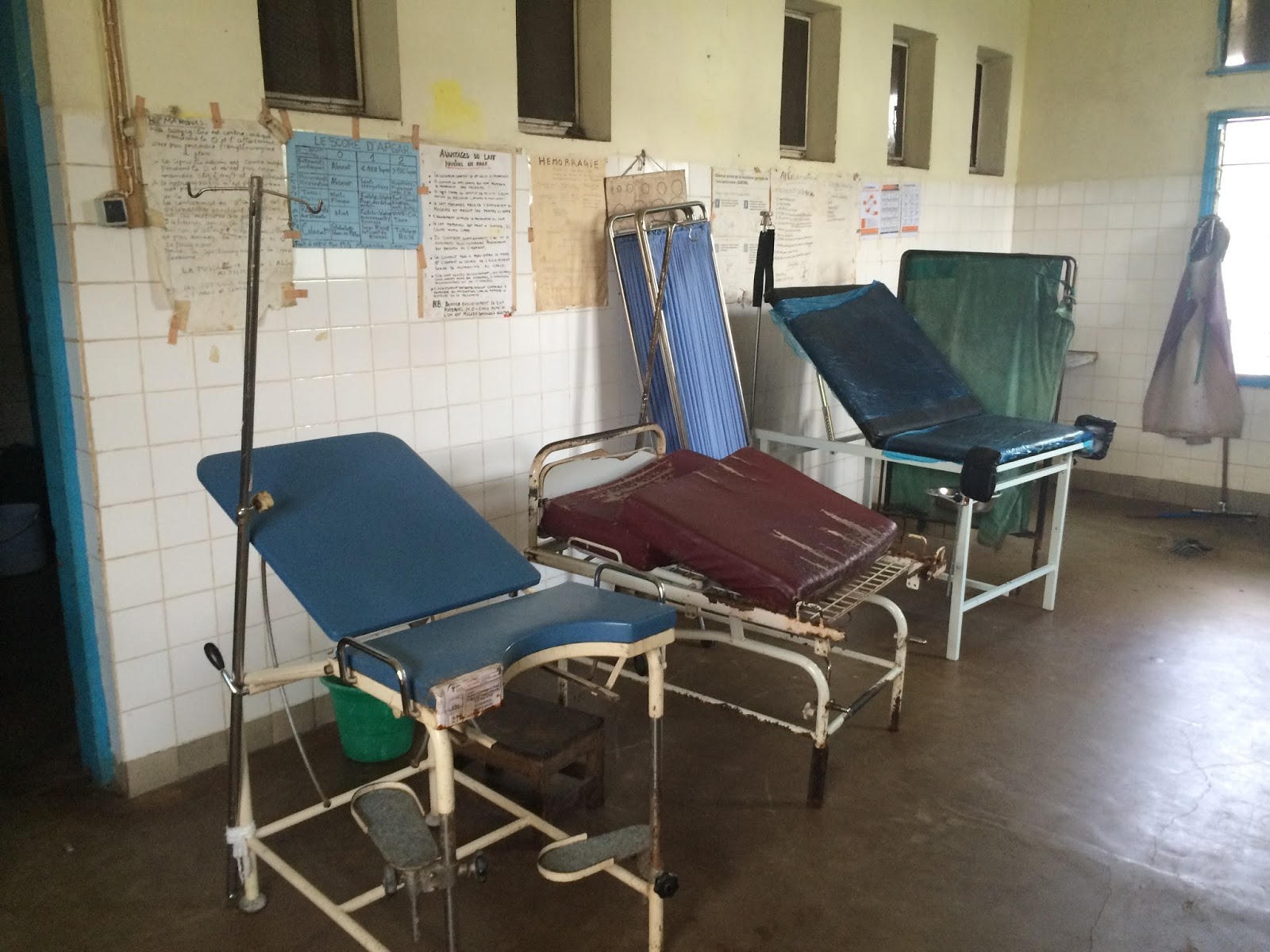
We made it to the maternity room, and to my surprise, there were quite a few nurses still around when normally there are just a couple who are staying for emergencies over the lunch break. This included two of the head nurses. I think perhaps they were waiting for me. It was no secret that my water had broken the night before, and there is definitely no HIPPA (privacy law) here- people talk about your business as much as they please. They busied themselves setting up the cloth privacy screens as the delivery room has 3 delivery beds (more like platforms or halves of beds) and 1 labor bed in the same room. There are also plenty of windows because natural sunlight is how they work most of the time.
Three delivery beds. Like the three bears:
small, med, and large :)
The bed I chose was the large one, complete with privacy curtains,
the sink on the right and the floor drain for cleaning up afterwards

 I asked someone to run and get Jen out of surgery, and quickly. And for the medical students to leave, all of them. Suddenly, I felt another contraction come and the urge to push, and Jen was not there yet. We realized that we had sent nonessential people away and now there was no one to go tell Jen not to delay. We looked around. Tim was essential as pediatrician. Ryan was essential as the father. Lauren was essential as my unofficial doula. And the nurses left were the ones who knew where medications and  equipment was. Finally, I think Tim went running off and to my relief, Jen was there for the next contraction. My other closest Congolese friend (besides Lauren) was with Jen as a translator, and mentioned that she needed to go back up to her house for a second. I said, “Don’t leave. The baby is coming now!” So she stayed, Kathy Rice arrived in the nick of time, and less than a minute later he was born! It was 1:30pm. We’d been there for about 15 minutes. I didn’t get vitals taken or give a medical history or anything—course they all knew me to some extent.

My favorite moment was turning around to look at him for the first time. I immediately said, “oh he looks like me!” delighted as Sydney definitely resembled her daddy. Jen gave him to me and we breathed a sigh of relief that everything had gone smoothly, and everyone had gotten there in time. Ryan commented, “Well, she (meaning me) is two for two. I know when she says she needs to go to the hospital NOW, she really means it, and probably should have gone a half an hour earlier!” We took pictures as he snuggled back into a ball on my stomach, and after several minutes we clamped and cut the cord. There is an open drain in the floor next to the delivery bed, and a couple of people poured water over me as my shower J.


Family selfie

We transitioned into the room adjacent which is private and was supposed to have been the new maternity OR (which still has yet to function, side note). But we got to rest for several hours there on a mattress they laid down and entertain a few visitors, drink orange fanta and eat mint M&Ms (specially imported for me by Jen from my mom). One thing I noticed culturally is that birth is a very spiritual experience here. Every one of the Congolese said, in effect, “Praise God. Glory to God. Thank you Jesus. Praise God.”Every. One. From the first moment he was out, and the first moment they got to see his face when visiting. It was a great testimony and something I’ll treasure about his birth.

Sydney came down with Nancy about an hour after he was born. She was very excited to hold and snuggle him, though at times her emotions made her a little too intense for holding gently. After some great family time, we heard thunder in the distance and approaching (it is still rainy season after all). I had been resisting the idea of getting driven home in a vehicle. I mean, it’s a 5 minute walk in normal circumstances and none of the Congolese ladies have the luxury of a vehicle for their much much longer walk home. But I finally agreed, especially with the impending storm and not wanting Zack out in the rain just yet.
First family pic
Checking out his toes
Checking out his eyes
We walked out to the vehicle with assistance from the nursing staff and a couple of medical students. As we walked out, a general buzz started and by the time I made it to the vehicle (perhaps 15 yards), people were pouring out of everywhere to see the white baby that was just born. Perhaps 100 people from the maternity to the post-surgical ward to the families staying in the courtyard to the pediatrics patients. They were all waving excitedly and cheering. Also something I’ll cherish, although I was very glad to be able to get away from the crowd by getting into the vehicle to drive home. I can’t imagine at my slow pace how many people would have paraded up to our house.

We got inside before it started to downpour. Rain is a sign of blessing here in Congo, and it certainly was a welcome relief from the heat. Tim and Kathy brought up a quiche for dinner for us, and we celebrated the day. And around 9pm, our German neighbors and their two visitors showed up at our back door, singing happy birthday to Zachary. Despite the hubbub and the community excitement, they were unaware of his birth until they checked Facebook just before the internet turned off. So they promptly came over to greet him. Oh the irony!

And now for the significance of his name. He is named after one of our mutual friends from college named Zachary (Zack) Saint. He was influential in Ryan’s first lonely semester in college, showing him how friendships should be more important than getting perfect grades and achieving for achievement sake, how being there for someone can make a bigger impact in the world than increasing one’s GPA by  a fraction. He is the reason that Ryan decided to become a part of the Kappa Zeta Chi (KZX) society at LeTourneau. He and Ryan were likely to have been co-captains of the soccer team during Zack’s senior year, but he unfortunately suffered a relapse of childhood leukemia. They anticipated his return the following semester, but received the news in January that he wasn’t doing well. A large group of guys piled in a van and started a cross-country roadtrip from East Texas to Pennsylvania, in the middle of a week of classes just as Zack would have done for them. They got a call when they were still a few hours away that he had gone to be with Jesus. But his legacy remains, alongside the legacy of his relative Nate Saint who died as a missionary to Ecuador. Our son is not the first to be named after him. And I doubt the last. Hard to believe it will already be 10 years on February 3.

Our Zack’s middle name comes from Saint Louis, a place that we left over a year and a half ago but that still is in our hearts. Louis is a bit less presumptuous than Saint as a chosen name, and reminds us of our friends and church and work family there.


Sunday, December 20, 2015

Walk With Me

A view of Vanga Hospital's tin rooftops on the left, the Kwilu River on the right, with fields and rainforest inbetween
It starts becoming light around 5am. Since I’m pregnant and am up frequently at night, I should know. Shortly after the light comes, there is a stirring in the community. As there are no competing sounds of cars or electricity (other than our own fans which run off our batteries), the sounds of birds singing, a baby goat protesting his mama, middle school girls bantering as they walk down to get water from the source, and the intrusive BANG of a mango falling on a tin roof fill the air. Around 5:45, only my fourth trip to the bathroom this night, I hear the first of the church bells go off that keep time in this village. I hear my daughter stirring, talking, singing her two-yr-old language. 30 more minutes until my alarm goes off. I crawl back under the mosquito net and try to find a spot in the foam mattress that hasn’t sunken flat from a night of body weight smashing it.
Mosquito netting over the bed
My phone alarm goes off. I hit the snooze. My daughter is still contentedly playing this morning. I wake a few minutes later and decide to get up. Another trip to the bathroom and I hear my sweet daughter call to me. “Mama. Awake!” I open her door and she stands up tall, all smiles, partly wrapped in the mosquito net she has pulled into her crib with her. “Mango, crash,” pointing to the window. “Baby, blankie, sleep,” putting her doll down on the bed. “Bonk! I fall, giggle” purposely running into the side of her crib and finding the result. She doesn’t seem to be in a hurry to get out of bed either. I put on my make-up as she decides. The 6:30am church bell rings.
The over 100 yr mission church, founded in 1912, still ringing its bell to tell the village the time
“Want to wake up Daddy?” I ask as I finally pick her up. “Yeah, daddy!” nodding her head. “Book! More more more, baby,” citing the name of a book. We go to the living room and retrieve the book. “Goose,”referring to another book about Petunia. We go back with the two books, and I plop her, heavy, on the bed. She jumps, slides, crawls over and says, “Daddy! Awake! More more more,” and I get my scrubs on and medical pocket reference books, fill my water bottle, and set my bag and white coat by the door. I contemplate a bowl of cereal. Nope, hypoglycemia. I decide on a glass of milk and a spoonful of peanut butter. I peek in on my family. They are both reading, separately, because that is what she asked for, I suppose—he’s reading about a silly goose, and she’s jabbering about a baby wanting more. I wave to him. Usually she opens the door for me and yells after me through the window, “Bye-o. Later. Mama,” but today I’m running late and she is happy. The 7 o’clock church bell rings as I brush my teeth. Yep, late again.
Sydney opening the door, saying "Bye-o! Later. Mama."
I walk down the sidewalk between the rows of purple tropical plant leaves, the sunflowers staked upright because their strength didn’t match their height during a recent rainstorm. Our sentinel opens our front gate with a familiar metal clang, saying, “Bon travail,” (Have a good work day, in French). I check my pocket- phone is there. My other pocket- my scrub hat is there. My bag feels light. Oh my water bottle. I trudge back up the sidewalk which seems steeper than normal today. I am always forgetting at least one thing, but I cannot survive the heat and humidity without extra water.
Our front sidewalk lined with flowering plants, a view from our gate
I pass the sentinel again as I depart and wave, a bit sheepishly. A family sits outside our fence, shaded by a large tree in the open watershed area ahead of me. A baby plays in the sandy dirt, tracing motion with a stick. A young man sits, waiting for someone to buy cell phone minutes. A mama arranges her bags of peanuts and a couple of pineapples that are for sale. A chicken picks up a peanut bag when she is not looking and scuttles off with it, making an impressive run as an 8 yr old throws available sticks and an old plastic bottle towards the chicken, who finally gives up her treasure as a stick makes a direct hit. She is almost proud as she kicks her chicken feet off and gets out of harm’s way. I’m halfway down the hill.
The nursing school just opposite our house
I pass nursing students, just in front of the male nursing student house, some are also selling cell phone minutes, to earn money for notebooks or pens, no doubt, but just a mere 20 yards from the first Vodacom rep. I cross a small landbridge that is successively being washed away in the rain—a culvert would work great right here, I think for the 20th time. The nursing school is on my right. The red flowering tree is quite beautiful, as are the tall palms that line one side of the school. The ground slopes away, down toward the Kwilu. I can see the other side rising up with its own set of palms today, no clouds, no haze, just raw beauty. Hospital staff and nursing school staff housing is on my left. The fruit tree, of which type of fruit I am clueless, has left a minefield of slippery apricot sized balls to keep my attention on the path in front of me. A goat follows its fellow goat through an opening in the natural bamboo fence—I suppose to see if the grass is really better on the other side of the nursing school fence.

I smile at the old and young women who line the path nearest to the hospital gate, selling peanuts and pineapple and green vegetables I still don’t know the names of. Yet another small stall sells cell phone minutes. That’s 3 Vodacom representatives in a 5 minute walk, and I know there are usually at least two inside the hospital property as well. I think about their meager prospects for making a profit, and also the lack of good jobs for young men. Quickly my mind turns to the women as I pass by the maternity ward, listening for babies crying, for the rare shout of a woman in labor, and searching the doorway to see if a nurse is anxiously looking out of it for physician instruction for a critical patient. Not today. I cross the sidewalk, pass the women sitting on steps—women in waiting. They are waiting for labor to start, or waiting for a loved one to be discharged, or waiting for a follow-up appointment. But all have come from a distance; otherwise they would not be paying to stay in a rudimentary cement room, lying on straw mattresses, and cooking food over a charcoal fire under a pavilion with 20 other women and children. Some days they stare or try to get their children to wave at the mundele (white person), but today they smile and wave, no doubt remembering my daughter’s bouncy red curls and shouts of “mbote,” (hope you are doing well! In the local language) the night before as we walked back from our daily swim in the Kwilu.
Just one of the pavilions where families of patients cook food, wash clothes, bathe, and live
I walk into morning report. A row of medical students who have been on overnight duty lines the front wall, 2 per service: OB/GYN, pediatrics, internal medicine, and surgery. The staff doctors and residents are in the front row, with 5 rows of medical students behind them. Each pair of students is called to give their detailed report of just one of the patients that they took care of overnight. Questions are posed by the staff, diagnoses and treatment discussed. Occasionally there is a disagreement and lively though friendly argument that breaks out among the staff. A student is sent to chase off the goat that is yelling for its mama right outside the open windows. I speak up and ask a few questions, clarifying a few points when OB/GYN is in front. I remain mostly silent for the rest, scouring my brain for the answers to questions in medical disciplines I haven’t studied since medical school.

Unfortunately, for today, both OB/GYN and pediatrics share the same mother-child dyad. A woman came in during labor at term, having faithfully attended her prenatal care visits (more rare than not). She has 2 living children, after which she had 6 newborns that died in the first day of life. Yesterday I had seen her when she was in early labor, trying desperately to find a cause through a good series of questions about her past history, through laboratory tests (of which we have few) and through an anatomy ultrasound to look for problems. I found nothing. And now I’m hearing in morning report that the child was born last night, full term, but didn’t breathe well. They ordered lab tests overnight which haven’t been done yet. The baby is doing poorly despite the oxygen given in pediatrics, oxygen saturation remains in 50’s (normal is 92+). I know I need to find this child right away, examine him for myself, and perhaps do an ultrasound to look for anomalies.

Morning report ends, and I walk out into the already bright sunlight. I talk briefly to the OB/GYN students, telling them I’ll see them shortly for rounds. I search out the pediatrics team, only to find out the child in question died while we were doing morning report. Not sure what is culturally acceptable, I ask another staff doctor if it would be appropriate to do an ultrasound on an already dead infant. I surely hope that some of the labs ordered had been done before the infant’s death. I search for the child, but they mention that he was no longer in the pediatrics ward. Neither had the lab work been done. Rats! I walk quickly over to the maternity, hoping to be able to at least examine the child. When I arrive, I am told that they have already come to get the child to bring him back to the village for burial. With how slow some things are, this one rapid act is extremely frustrating. I now have no more information for this mama than she already knew before—all of her babies are dying of something, even with good pediatric care available immediately.

I return home quickly to use the internet to write an email. Maybe my high risk maternal-fetal medicine professors from residency can give me something to go on, something to tell this poor sad mama. I drink more water while waiting for the wheel of death, that circle that keeps going round and round on the computer with slow internet—a fitting name for today. I prepare mentally for the rounding on maternity. I don’t have anything to say to that mama yet.

A view of the maternity, with covered sidewalk connecting the rooms
I make the 5 minute walk back down to the hospital quickly. We start in the post-cesarean section room that has 9 beds in it. Today most of them are doing well. One hasn’t bought any medications yet, antibiotics nor pain medicines, and she has a high heart rate and fever. I have lost patients to overwhelming infections treated to late because of inability/unwillingness to pay—or because they flee in the middle of the night and return with an infected wound, sutures still in place. I know I’ll pay for her antibiotics and whisper to the nurse to bring me her bill after rounds. It’s only $10 out of a $120 bill for the surgery and hospitalization. Turning back to the medical students, I ask questions about the indications for cesarean sections, their risks. We move on to the next room where there are some women who have had hysterectomies, then onto a room full of women still pregnant, hospitalized for malaria or typhoid fever or kidney infections. I prescribe a few antibiotics, change a few plans. Walking out of doors (imagine an old-school motel where doors to rooms open to the outside with a covered sidewalk between), a woman comes up to me with a paper and asking to see me. Yes, around lunchtime after the medical student activities, I assure her. Then it’s on to the postpartum room with 12 beds in it, mostly full of mamas who delivered vaginally without problems, babies in arms or nursing, but one doesn’t have a baby and I know why. I can’t talk to her today. I have nothing to say. Tomorrow, I think. I hope tomorrow I have something, though I doubt it.

The group of students, tired of standing, trudge into the meeting room where one of them has prepared a presentation on bleeding in pregnancy. A nurse pulls me aside as I’m walking into the meeting room. Her brother is in the emergency room and needs surgery. Can I help? Oh, and there is another patient who wants to see you after the presentation. Too many people need me. I feel like a mom with toddlers pulling on her ankles while she is trying to make dinner. I tell them all I need to finish up with the medical students first. I escape. The medical student is talking already. I follow most of the French, though some words I have to clarify still. Medical terminology wasn’t emphasized in language school. Critique, however, was emphasized. Immediately after the presentation, the staff doctors (me included) evaluate aloud the presentation. The other doctor states, “Well, that was poorly presented. You need to organize it better, look how many people were sleeping during it.” And instead of being dejected as I would have been in his shoes, he takes notes on what to do better next time. This is definitely a French system. I begin, “Thank you for the presentation. Next time, if you look at the audience and don’t read off the computer screen as much, it will be better. But the content was good.” Yes I’m American. I have to sandwich the bad comments between something positive.
The group of medical students and residents working in OB/GYN
It’s noon. The students scatter, as do most of the nursing staff. They take lunch break seriously here, for 2.5 hours. I’m hungry, but since I don’t have regular consultation hours, I take patients as they come to see me in the maternity. The nurse waiting for an answer on whether I’ll pay for part of her brother’s surgery looks at me. Not now. I call a nurse who is on call over the lunch hour to come in to help with translation. Surprisingly, now there are 3 patients waiting. We start with the first. Pain. Menopause. Irregular periods. I’m happy I can give them instructions on how to improve their health that don’t require surgery or expensive medications. Soy beans, palm oil, reassurance. All three are similar cases. I finish fairly quickly, as documentation here is not as necessary nor do I always have the proper French words to explain my findings. Finally, I finish, and as I head out the door, I turn to the nurse still waiting on my answer and hedge, “Come up to my house after lunch. I have to discuss this with my husband.”

I walk up the hill, which at times seems like a mountain. Halfway there, I make a detour and walk through the nursing school. I’m looking for the academic dean, because I’ve been given a few donated computers for the nursing school and need to distribute them. He has already gone home, so I continue through the field, past the new building for training nurses in a practical hands-on way. A nursing student stops and asks me to give her money for books. Ah, the requests don’t stop. Unhindered, culturally-appropriate here, the requests wear on me. I try to think of a good way to banter back, as I sometimes say to people asking for food on the road that I’m not a cook, but I’m tired. I just say no.
The path back up to our house, nursing school on the right, our house at the very end of the path, top of the "mountain"
I’m late for lunch, so Ryan and Sydney have already finished. Sydney is taking a nap. I sit at the table, grateful to sit, grateful for food already prepared for me and mostly still warm, always tasty, and grateful that I can turn a 12 volt fan on as afternoons can be stifling without wind. I overhear our house help talking in more energetic than normal tones. I look over and they come out of the kitchen. The gardener has just returned from the market with eggs for dinner. He overheard on the road that there had been an accident this afternoon. The details trickle out. My cook’s neighbor, a motorcycle chauffeur, was killed in a head-on accident with a vehicle. Not only that, MY neighbor’s 10 yr old boy was also killed, and his mother sustained significant injuries but is alive and being treated now at the hospital. Oh death, you are so frequent and near here.

I continue to eat, mulling over thoughts of how prevalent death is here—so IN YOUR FACE. What if that had been Sydney? Or Ryan? My empathy strength seems like a curse now. Soon, we hear it… the inevitable wailing and mourning coming from the direction of the hospital. It happens at least weekly, with the mourning friends and family passing by our house. This time it is during daylight. I follow our house-help to the front gate to watch. And I regret it. It is children. A lot of children, lamenting their friend. There are a few adults too, that look like mamas. A couple of men carry a stretcher. I want to look away, but I can’t. It is my neighbor boy, all of 10 yrs old, a surgical wrap seems to keep his head on his shoulders. Still. Silent. Tears come unbidden. The procession is now at our house and passing by. I turn and walk back inside. It’s just too much. This suffering. He is too young.

I finish eating. A sentinel who works for a missionary currently out of town comes to get money for his sister’s hospitalization for malaria. I give it. He asks if I’ve heard the news of the accident. He gives unsolicited new information. It was a missionary vehicle. My heart sinks, thinking of which missionary is in the town nearby. Relief washes over as the sentinel explains that there was only a chauffeur in the vehicle at the time, and he is now at the police station for protection. At least there will be no cross-cultural interrogations. Nothing is simple here. I receive a phone call from the owner of the vehicle leant out this week. She wants to know details, and I give her what I’ve heard. When I mention that the chauffeur had gone to the police, afraid of retaliation, this seasoned missionary replied, “and with good reason!” I’m feeling the gravity of cultural differences.

On the heels of that phone conversation, the maternity nurse comes once again, asking for money for her brother’s surgery. I’ve looked it up over lunch—probably not an indicated surgery. I have had time to wrestle over this persistence. I don’t have money designated for the sick other than for patients I’m treating in the maternity. But this is like a family member asking for money. She is persistent. She is desperate. I finally decide I’ll give $30 as a gesture of friendship. I also explain that although I’m no expert, I think they could avoid surgery and act conservatively. She thanks me, then asks if I’ve heard of the accident. Yes. Too many times.

I am no sooner in the door when I receive a text to come to the maternity for an urgent patient bleeding after a vaginal delivery. I send a message that I’m on my way, telling them to give cytotec intrarectally to stop the bleeding. I quickly finish my glass of water, thankful that I don’t have to worry about cleaning off the table or washing dishes. I walk back to the maternity ward, being told about the moto accident two more times en route. No need for TV news here, I think. This is how word travels fast. At the labor room, the nurse has just finished placing the cytotec. I do an exam, and I’m thankful that the bleeding is currently much less than what the floor gives evidence to. I remove a few clots, and determine she doesn’t need anything further.

There is another patient waiting to be seen. I walk to an open room, sit down with her and another nurse, and go over her options for fertility treatment here. I tell her I’ll need to see her tomorrow in ultrasound to see what her ovaries and uterus look like. She is satisfied. Thunder rolls, and a rainstorm begins. But I need to go see a colleague who is past her due date. She is waiting for me at her house, wanting to discuss induction options. I decide the rain will not deter me. It is the rainy season after all. If I let the rain keep me from going out, I’d be stuck either in my house or at the hospital, potentially for hours. But a great protest breaks out as I’m leaving the maternity. First from the nurses, who laugh a bit at me after realizing I’m seriously going to walk out in the downpour like this. Then the patients and family members lining the covered sidewalk outside the maternity object. Some speak to me in broken French, others only the local language. Some are sitting against the wall, others filling containers, taking advantage of water flowing off the roof, others standing and just watching the deluge. I insist that I’m walking out into it and I’ll be fine. I’ll simply be walking through God’s shower, just as they fill their buckets with water to bathe their children in later.
The path down to the hospital becomes a small stream during rainstorms
Like a gentle caress, the water comes. It tries to find its way through my white coat and scrubs. My eyebrows drip. But it’s warm, and there is no lightening threatening my steps. The bricked walkway leading out of the hospital is now a stream, always carrying the sandy soil further downward and toward the Kwilu River just on the opposite end of the hospital. I turn right just after the gate instead of continuing up that mountain stream. I arrive for the home visit, my too-pregnant friend is surprised but happy to see me. We discuss options, pros and cons. We decide that Friday is the day, though both of us hope she has the baby by then.

It is still raining, though lighter still as I walk out of her house and on home, past the giant palms, the papaya tree that’s leaning too far over the already narrow path. There are still pieces of the afternoon left. I can be productive. But upon arrival, I discover via text that we’ve been asked by the hospital administrator to use our internet, computer, and printer to print out a document sent from Kinshasa for the official traffic report. I sit down at the computer, and realize quickly that it is impossible. The internet has been disconnected to protect the equipment from all-too-frequent lightening strikes. I relay the message of this problem to Ryan, who then walks from the house he is installing solar panels on to the internet room to reconnect to the satellite for this urgent need. The task eats my afternoon.
Our normal evening activity is swimming in the Kwilu just after work, just before dark
Having lost motivation, I decide to wash away the sweat of the morning with a bath. It’s SO cold. The water just drips. Our solar camp shower has given in to the harsh sun and frequent use, and now is obsolete with a few holes near a herniated pouch. Jumping in the Kwilu is much preferred over this, but with the threat of lightening and continued storms, this will have to suffice. Sydney is more than ready to hang out after I’m clean, and I take her from her best friend and nanny, Nancy (known as nounou). We read books while going, “rocky rocky” in the wonderful over 100 yr old chair in the corner of our living room. It isn’t long before Ryan comes in, followed by Tim and Kathy. Ever since we went to language school together in France and lived across the hall from one another, we’ve had the tradition of eating most dinners together. So even with the 15 minute walk now that’s between us, we’ve continued the habit. I turn on the stove to reheat the pork tomato sauce and the rice that the househelp have left for us. I’m grateful. For food, for not having to cook, and for a gas stove, although I miss a microwave.
Sydney reading to her monkey in the 100 yr old rocking chair
It gets dark during mealtime, as usual, though it’s only 6 pm. The geckos come out, and Sydney is too distracted to keep eating. “Gecko! Mommy. Daddy. Kat-y. Gecko, look! Baby, cute!” Soon after, “I done. Wash.” She climbs down off the stool and onto the chair, then putting her hands together, she runs off toward the bathroom. Ryan finishes eating sooner than he’d like to help wash her hands. Sydney takes the cushions off the couch, one by one. She then gets on the bare board, says, “One, two, three, Sautez! (French for Jump!)” She steps off the couch after rising up on her tiptoes. It’s close enough. Several times I think she’s going to fall when she reaches the unstable cushions, but she doesn’t, smiles, and does it again.
Sydney pointing out the geckos
The roar of the hospital generator alerts us that it is just after 6:30pm. The nearby Congolese houses and the nursing school study rooms light up like a Christmas tree without color. It is the start of our 3 hours of electricity in this village by generator power. Otherwise, we are dependent on solar energy or battery power, and most of the village does not have money for that. Thankfully, there are solar panels in many areas of the hospital which provide light when needed. As it is the time when we have the most access to electricity, I run to grab the laundry basket. I plug in the small European sized front-loading washer that is located in our back covered entryway. I load it full of scrubs and towels, and start it. It usually takes 2 hours, after which our sentinel will hang the clothes to dry in the entryway as well. I remember to take in the cup I’ve used to pour in the laundry powder. If not, with the humidity here, it will be partially filled with water by morning.
The back of our house, with covered entryway (the door you see) where we do laundry and hang clothes at night
The Rices head back to their house as we get Sydney to bed. It’s nearly the same every night. Sometime around 7pm, we brush teeth, change her diaper, and sing “Jesus Loves Me” as we put her under her mosquito net and into the pack n play. She rarely protests. After all, it’s been dark over an hour. I walk out to the living room and tidy up the cushions, put away yesterday’s clean laundry. Ryan has already put all the dishes in the kitchen.


Playing with Daddy at the end of the day
It’s now time to use the internet for the remaining 2 hours that it is available to us. With satellite internet, an electrical system prone to damage from lightening, and with living in the lightening capital of the world, the internet is disconnected from all electricity around 9pm. So I hurriedly try to catch up on emails, send out requests for medical advice, chat with friends on Facebook, learn about world news, and I write this blog. It’s been a good day. I thank the Lord for all He’s given us and provided for. And I pray for all the patients in the hospital that are suffering, the mama who’s lying in the hospital bed, mourning the loss of her son and hurting from injuries herself. I pray for the large group of friends and family gathered at the nearby church to mourn the loss of the motorcycle chauffeur and the little boy. They will be there all night, sitting, singing, just being together in solidarity. This is life and death. This is Congo.

A malnourished child, just outside the pediatrics ward
The Kwilu River at morning light

Tuesday, November 17, 2015

Ovaries, Victories, and African Efficiencies

Ovaries
It was diagnosed by ultrasound- an enormous mass filling her pelvis. Also on the report was the statement that the uterus could not be visualized. Patients here frequently have surgical scars for which they have no knowledge of the type of operation, so it was unclear whether she had already had a hysterectomy. We scheduled her for surgical removal of ovarian mass. At the operation, we noticed that both fallopian tubes were attached to the mass, and its origin (right or left) was a mystery. We carefully extracted it without spilling its contents as ovarian cancer can be spread during surgery. I was assisting one of the other staff doctors, and he informed me that there, indeed, was no uterus present. I found this a bit hard to believe, with both fallopian tubes connected to the mass. Just below the mass, I located a slightly more firm part and told the other surgeon that I suspected that it was the cervix.

After removing the mass completely and closing the abdomen, I took the mass over to further investigate. On close inspection, it was clear that the uterus, small as it was, was connected to the mass. I was able to show the curious medical students the origins of the fallopian tubes and the parts of the uterus. Then I opened the mass. It was almost all liquid, but to my great joy it also contained hair and some calcium deposits (that we like to call teeth) - it was a benign growth and the woman had a great prognosis. These discoveries are a joyous occasion and just an example of some of the bright moments working here in Vanga.
Just before opening the mass to find out what it was... usually a pathologist would do this.
Victories
It was the morning before my first scheduled lecture at the nursing school for the 1st year midwife students. I was sitting in morning report by the students when I saw one of the interns who is working on OB/GYN leave suddenly. He returned a short time later and talked with another staff doctor working on OB as well. The staff doctor looked at me and made a slashing motion with his hand, indicating that someone had come in that needed a C section. I walked out of morning report to talk more with the intern. The patient had come in after laboring for 2 days at the health center close to her house. She was completely dilated, but had been pushing since the evening before, had a small pelvis, and the baby wouldn't come out vaginally. She definitely needed a C section, he said, and told me he had the nurses getting her ready. I told the intern that I would not be able to do the C section as I was scheduled to teach, but I'd go evaluate her myself and return to morning report after seeing and verifying the necessity.

I walked into the labor room, and the patient had an IV and urinary catheter already placed. Indeed, she was tiny and appeared at high risk for obstructed labor due to a small pelvis. But as I walked toward her, I noticed that I could see the baby’s head. Unless all of that was edema (basically fluid under the skin), that baby’s bony head had already passed the point it should have gotten stuck with a small pelvis. I asked the nurses standing there, “So have you asked her to push?” They replied negatively, because obviously she hadn’t been successful for over 13 hours of pushing… I put on my gloves. Indeed her pelvis was tiny, and the baby’s head was clearly pushing the limits, but I felt like the bony parts of the head were past the bony parts of the pelvis. I told the somewhat incredulous nurses that we needed her to try pushing. Maybe the long journey had adjusted the position, maybe they didn’t have her in a good position before, and maybe she could do it. Less than 5 minutes later, she delivered her baby’s head. At this point, my mind started racing because I just knew the shoulders would get stuck and we’d have a different emergency called shoulder dystocia. However, the shoulders came, and she didn’t even need stitches!

I walked back into the morning report about 20 minutes later, and I made a motion with both of my hands to the other staff doctors signaling that she had just delivered vaginally. He got a surprised grin on his face, and morning report concluded without further interruptions. It was a great teaching moment for the nurses and the intern. It is important to always examine the patients yourself, and always give the mama a chance to deliver vaginally as long as the baby is doing okay. I was also able to show them a couple of simple maneuvers that came in handy in this case.

I finished the morning with a very enthusiastic group of new midwife students. Despite some limitations with my French, they seemed to understand and enjoy the teaching quite a bit, especially as I am currently in my third trimester and they were able to see first-hand some of the things I was teaching about signs of pregnancy. Some days here are like that, with happy endings, teachable moments, and the feeling that I made a difference in the healthcare system for the women in this country.

Efficiencies
Truly, you read that right. I am talking about how very efficient I can work sometimes here in this context. One Saturday after rounds were done around 11 pm, I had 2 patients waiting to see me for a consultation. I decided that they both needed ultrasounds, and since the ultrasound room was open until noon (after that it simply requires that I open it with a key and don't have help), I walked with them over to the pediatrics building where the ultrasound room is located. "Oh Dr. Janeen, we are so glad you are here! We have a patient for you." This is more often than not the phrase I hear when I enter the room with one of my patients. 

So I proceeded to do not two, but three ultrasound examinations. One of my original patients I gave a prescription to and sent home, the second I decided I needed to do an exam in the operating room to remove her IUD (intrauterine device for contraception) because though the strings were not visible, I could see it in place on ultrasound. The added-on ultrasound was a pediatrics patient with cyclic pain for 11 months but no period yet. The opening to her vagina was blocked by a septum. This is a rare condition, but I have seen it twice in 2 months here. Also, it's easy to treat and has a good prognosis. But with significant pain and an easy fix in the OR, I felt like it would be a waste of resources to give her pain medicine when I could just make an opening to relieve the pressure in a short time.

I walked with the two patients needing surgery to the operating room. It was not yet noon, so I knew the staff would still be there, though not for long as they take their lunch breaks from noon to 2 pm unless there is a surgery planned. I discussed with the chief nurse in charge of the OR that I needed to do two quick procedures in the operating room. At first, he said, "Can't it wait until Monday?" (a scheduled surgery day). Knowing he is a softie, I said, "Go look at her face and tell her we'll wait 2 days." He smiled, and walked to meet the patient. Sure enough, after seeing her pained expression, he put his arms around her shoulders, looked at me, and said, "Ok, let's go." 

I changed scrubs while they prepared the tables, which were in the same room together. I quickly located the IUD and removed it without difficulty. Secondly, I walked the 15 feet to the second table and made an incision in her septum which immediately relieved the pressure built up for 11 months in her tiny body. I left a little after 1 pm to eat lunch. I could NEVER do that in a US hospital for a clinic patient. I had seen 2 patients, done 3 ultrasounds, and performed 2 unscheduled minor procedures in the OR in a couple of hours. Some things here can be very efficient!

Monday, October 19, 2015

Unreasonable Hope

She lay there on the operating table, and as I watched her breathing, her hair discolored from malnutrition, her thin frame like a child's beneath the surgical drapes, I knew that despite our best efforts we had not been successful. She was no better off than before we started. And yet, I had an overwhelming, confusing sense of peace. I felt an unreasonable hope for her. 

Always be prepared to give an answer to everyone who asks you to give
 the reason for the hope that you have. -1 Peter 3:15

The OB/GYN ward in the waning hours of the day, around 5pm
 She was a "typical" fistula patient... very very poor, abandoned by her husband. Her only child had died during labor many years ago, and she has been leaking urine constantly since then. We had removed a 4cm stone from her bladder about a month ago. It is important to wait to repair the hole in the bladder because of the high rate of infection associated with stones and thus a high failure rate in closing a fistula. After the initial operation, we waited until she was fever-free for 2 weeks, adding on a week because of one thing or another (couldn't find her in the hospital grounds to get her registered for surgery multiple times). Because she had already experienced a delay of more than a week for no reason, I insisted on adding her to the schedule as there were only 8 other major cases listed (sometimes there are 10 or 11!). I was trying to be her advocate.

Hindsight is 20/20. The downside to adding her to the schedule was that she went last in the day. We were all tired, and 5:30 pm is not a good time to start any non-urgent case, much less a very difficult case. We started to operate, and immediately I realized there was a ton of scar tissue and very little good tissue left. Secondly, there was not just one but two holes in the bladder (one was clearly visible and fairly "easy" to close). As the surgical team only takes breaks in-between surgeries to eat peanuts, tea, and bread, at this hour, I was quickly becoming hypoglycemic with my pregnancy as well. I switched back and forth being the main operator and assistant with another experienced general surgeon. Long story, a bit shorter, we stopped the operation vaginally after we realized that most of our sutures were just pulling through very fragile tissue, and we then made an incision in her abdomen from above. Upon entry, her bladder literally tore open. And my heart broke with it.

At this point, it was 7pm. I was feeling very poorly, and had to step out of the surgery. Open abdominal operations on the bladder aren't really my specialty, but I felt guilty nonetheless. I went out to take off the hot surgical gown and get some water, but realized I had already finished my bottle of water. This was not good as there was no tea left, and I can't drink the unfiltered water here without potentially getting sick. I sent an urgent message for someone to bring me a banana and water if possible. After the banana and water, I indeed felt much better. The operating room staff instructed me to leave and go home, but I knew I couldn't. She was my patient. I had insisted on her being on the schedule. To top it off, I knew the surgical assistant, herself, was sick with malaria and yet she was still there. No. In good conscience, I couldn't leave.

Back in the operating room, the surgeon told me he had found not 2, but 3 holes in the bladder. He had repaired 2 of them from above, but was now again trying the repair of the 3rd vaginally. As I didn't want to "waste resources" by scrubbing in again and using 2 more pairs of gloves and another gown, I stayed out but offered advice. I think one or two comments made a difference in his management. But he otherwise closed the holes as best he could. (I'd say he is king of doing surgery in the dark- not always precise, sometimes potentially causing harm, but probably more people are helped because he isn't afraid to try.) I certainly would have done things differently, but I had no choice but to abdicate my responsibilities and my position as the operator in this case because of my health.

It was as they were closing the bladder and abdominal incision from above that I experienced that unreasonable hope for her. I've heard people say things about their ailing grandparents like, "I know they will go to a better place..." but I've never really FELT that hope and that gratitude for good endings for someone, let alone someone so young. And that phrase- that cliche- didn't capture the peace that came over me. I have no doubt that God will redeem her, that God will completely restore her health when she is in heaven, and that it will truly be a wonderful ending. I may have "failed" to see God's kingdom come here on earth as it is in heaven through a physical healing now, but I have the HOPE, the CERTAINTY, that His Kingdom will come and she will have a new body. And in the meantime, perhaps she experienced a bit of emotional/spiritual healing by the love shown to her by those of us here at the hospital.

Pic taken from the OB/GYN ward towards the lab, surgery, and post-op.
Some of our colleagues work in a remote area of Cameroon, and they recently blogged about how we can best love the poor around us. I'll include the link, and I hope you'll read this story in full, but it describes a bit of what I was feeling.

"There are so many problems here: illiteracy, disease, very limited access to medical care and clean water, violence and so on. Honestly, I want to try to fix them all. Although we can attempt to solve these problems, we want so much more for these people then just clean water. Jesus said himself that everyone who drinks physical water will be thirsty again but whoever drinks of the water that he gives “will never be thirsty forever” (John 4:13-14). If this is what Jesus supplies, then is this not a long-term solution to Simon’s water problem? In the same way, even as we are ready to help Simon pay for a surgery, what we really want for him is to get a whole new body that will never pain him again. Every day he walks very far away on a dirt path to his field, and although it would be nice to have a smooth paved road, what we really desire for him is to parade through the clean, gold-laden streets of Heaven forever."


Always be prepared to give an answer to everyone who asks you to give
 the reason for the hope that you have. -1 Peter 3:15

I'll end with a second quote from their blog:

"So when you pray for [our fistula patient], pray big. Pray that [she] will be able to have every needed surgery, but do not forget to pray that [she] will get a whole new body. Pray that the Lord will provide [her] daily water, but remember to pray that [she] will follow Christ and never be thirsty again. Do not just pray that [she] will have a nicer house but pray that [she] will live in a mansion made for [her] by Jesus. Pray [she] will not spend [her] days worrying about what [she] is going to eat, but pray that [she] will seek God and ask God to “worry about” providing for [her]. Let us not just give our neighbors an America here in Africa, let us aim to give them the very Kingdom of God."
http://haretranslation.blogspot.fr/2015/09/how-can-we-best-love-poor.html#links

Saturday, September 19, 2015

"Puff! Puff! Puff!"

It’s not what you think. Trust me. Has nothing to do with drugs, or make up, or girls, or a magic dragon, or even CPR. It is a phrase that has uplifted me in the midst of a difficult week. 

There are times when I am struck with an unreasonable feeling of discouragement or loneliness. It happened this week again. We were able to reconnect with some friends and family over the weekend, and should have been refreshed when the week started. Instead, I watched as Ryan struggled to find his purpose and place, feeling frustration over our lost shipment and over the fact that he hurt his knee playing soccer (minor this time) and is unable to connect on the one place he is most comfortable- the soccer field. Instead, I felt lonely for our friends we have left. Instead, I felt as I worked on Monday that I was working in the dark without cultures or pap smears or the ability to biopsy. This feeling of working in the dark, along with the numerous patients with cervical cancer too advanced to operate, gave me pause as I advised a resident doctor not to do a hysterectomy; nevertheless, the cervix looked ok (to the naked eye).

I felt prepared for heat, for mosquitoes, for limited options for medicine. I felt prepared for the inability to perform minimally invasive procedures like hysteroscopy (looking with a camera at the inside of the uterus) and laparoscopy (doing surgery through tiny holes with a camera). I felt prepared for difficulty with follow up with patients, for tropical diseases and conditions I’d never seen, and for bigger complications like uterine rupture. But I didn’t feel prepared for the battle within my mind of just how inadequate I might feel when asked for advice by residents and students, or for the loneliness that I might face, or for the darkness of discouragement. But God is good, and He reminds me time and time again to rely on Him for strength and provision of grace. It is so good to know that He is the one ultimately in control.

Four things encouraged me this week, one of them being “puff, puff, puff!” First, I was able to talk with a colleague who is working in Kenya with Samaritan’s Purse as well. Her experience is much the same, and that certainly helps me not to feel alone. I know there are many many people lifting us in prayer daily. Secondly,  I also have been able to keep in contact especially with two very close friends from language school- we are all living in different places here in Congo, and that has been a great source of laughter and sharing of tears. The third and fourth things happened while teaching in the maternity ward.

Sydney also got to practice helping the baby breathe
We started teaching a course, internationally known, called Helping Babies Breathe, for the maternity nurses.  Dr. Rice and his wife Kathy, nurse educator, and one of the Congolese doctors and I directed the course. It is so much different than the rote memorization I think they are used to. We had life-like baby mannequins and real ambu-bags and practiced every step of the way. At first, it was like pulling teeth to get them to come up from their chairs and practice with the babies. Kathy and I acted like crazy pregnant women coming during active labor, and soon they were laughing and playing along. And even though what we were practicing was very simple (we only did the first part which is when the baby is breathing and everything goes smoothly), we could immediately correct the small errors that they were making.

I watched as one of the older nurses went literally from sitting in the corner with a disinterested look on her face to actively participating, feeling for pulsations in the umbilical cord before cutting it, and telling the younger nurse, in French of course, “Well we haven’t been doing it like that, but we are going to start doing it like this from now on!!” I also watched as she connected what she had seen me doing in a delivery with her earlier this week, which at the time had seemed quite strange to her, with what we were teaching them now. She was all smiles with her new knowledge of the importance of drying off the baby, skin-to-skin contact with the mom, and waiting to cut the umbilical cord.
Practicing Helping Babies Breathe
And lastly, I spent one afternoon in the maternity ward, while waiting for patients or any questions from nurses, with the medical students and a resident. They had their heads buried in their books at first, but I told them I thought it was important during their clinical year that they be taught practical and hands-on things, as these are hard to learn from just reading. I brought in my suture training kit, and I told them we were going to practice tying surgical knots. Here in Congo, they almost solely use instrument ties as this conserves the suture the most and is the most simple. But time and time again, I watch as they make one crucial mistake in this knot which makes it more like a slipknot and susceptible to come untied. I first reinforced with the students the concept of square knots, and changing directions. Then, we moved on to one-handed and two-handed knots. They eagerly tried it out, teaching each other after they had figured it out. And then they would groan as I told them they had to switch hands (dominant hand switching to non-dominant hand) because from my experience, if they can switch hands, they truly understand the theory and technique of that knot. The resident explained that they had only been taught one part of the one-handed knot in their school. So when I explained that that would make more of a slipknot than a square knot, and had to be paired with its opposite, they were eager to call the first part the Congo knot, and second the Shannon knot.

One of the students, in particular, looked to me as he tried out the two-handed knot. Each time I affirmed that he had the technique or movement right, he nearly shouted with excitement, “Puff!” So as he got more proficient, I just saw his smiling face as he went through the motions, “Puff! Puff! Puff! Puff! Puff!” The joy of teaching is summed up in that face, in that smile, and in that shout of “Puff!”

I joked with him that I would go to bed that night, hearing him in my head saying over and over, “Puff! Puff! Puff!”